How to get iodine on a vegan diet
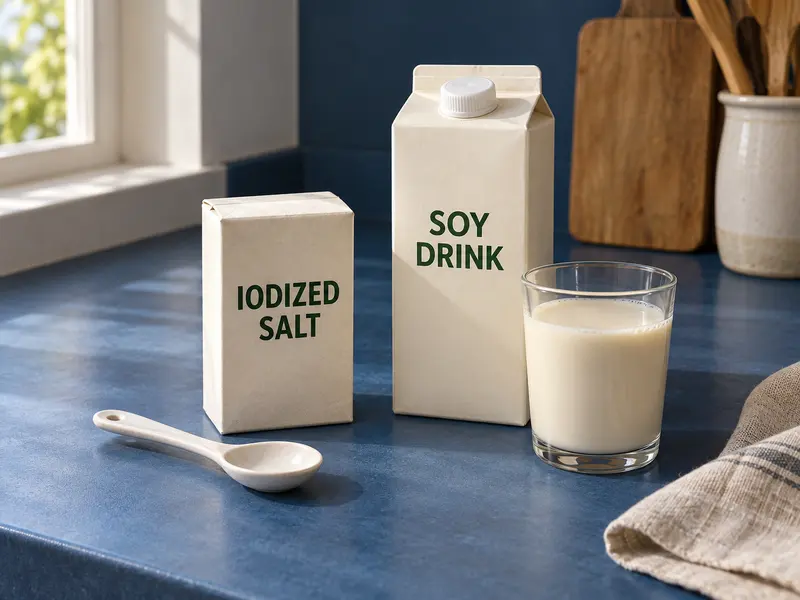
A plant-based diet needs a dependable iodine source, which may come from iodized salt, foods with iodine added, supplements or a combination. Beans, vegetables and enough protein do not by themselves establish adequate iodine intake. For healthy adults aged 19 and older, the US and Canadian reference intake is 150 micrograms daily; pregnancy and lactation have different requirements. Start with what your actual products provide, while keeping sodium limits and thyroid conditions in view. [1][2]
Keep intake targets separate from label percentages
Iodine is needed to make thyroid hormones. The amount required is small, but both inadequate and excessive intake can cause problems. A reliable source belongs in the same practical review as B12, calcium and other nutrients covered in our supplement overview.
The Health Canada reference table gives these values, consistent with the US reference intakes:
| Life stage, age 19 and older | Recommended dietary allowance, total daily iodine |
|---|---|
| Adults who are not pregnant or lactating | 150 mcg |
| Pregnancy | 220 mcg |
| Lactation | 290 mcg |
These are total dietary amounts from foods and supplements together. They are not instructions to take that much in a tablet on top of whatever food supplies. The adult upper intake level is 1,100 mcg daily from food and supplements; it is an upper boundary, not a target. The table is for generally healthy people. Thyroid conditions and other medical circumstances can require individual advice.
Micrograms may appear as mcg or µg. One milligram, written mg, equals 1,000 micrograms. Keep the unit attached to the number when comparing a food label with a supplement bottle.
What the vegan-diet studies actually show
Two small observational studies illustrate why iodine sources deserve attention:
| Study | Urine results compared | What else matters |
|---|---|---|
| Boston-area adults, published 2011 | Median iodine concentration was 78.5 µg/L in 62 vegans and 147.0 µg/L in 77 vegetarians with urine results | One spot sample; no omnivore group; no significant group difference in TSH or free T4 |
| Berlin RBVD adults, published 2020 | Median concentration was 28 µg/L in 36 vegans and 74 µg/L in 36 omnivores | Samples came from 24-hour collections; no significant group difference in TSH |
The Boston study used a local, self-selected sample and excluded a kelp-using vegan with an exceptionally high result. The Berlin study also used a small local sample; iodine supplements were reported by five vegans and three omnivores. Diet groups were not randomly assigned.
These results show lower group concentrations, without establishing that every vegan has a deficiency or that the diets caused thyroid disease. The amounts are micrograms per litre of urine, not micrograms eaten per day. Hydration, recent intake, supplement use and the surrounding food supply affect interpretation. Similar average thyroid markers also cannot establish lifelong adequacy for every participant.
The WHO document on urinary iodine concerns population assessment. A single spot result should not be treated as your personal diagnosis. Bring concerns about intake, symptoms or thyroid health to a clinician rather than comparing one urine result with a population cutoff.
Check the salt product and its country
In the United States, salt iodization is voluntary. Specialty salts are often not iodized, and salt in commercially prepared food is not a dependable iodine source simply because that food tastes salty. The NIH iodine fact sheet describes this distinction. Look for explicit iodization information on the package you use.
Canadian rules differ. The Canadian Food Inspection Agency explains that standardized salt and sea salt sold for table or general household use must be iodized, with iodide identified on the main display panel. Noniodized salt can still be used as a food ingredient. Products under the distinct common name “sea salts,” and salt substitutes, have different provisions. Do not assume that every salty prepared food or every specialty product supplies a predictable amount.
An ingredient list may identify potassium iodide, but prepared-food labeling does not always reveal all the components of its salt. If a food is supposed to carry a substantial part of your iodine plan, ask for its iodine amount when the available information does not give one.
Compare real labels without turning them into a salt target
These two US manufacturer labels provide concrete examples:
| Named product and stated serving | Iodine listed | Useful context |
|---|---|---|
| Morton Iodized Table Salt, 26 oz package: ¼ tsp, or 1.5 g | 68 mcg | The same serving lists 590 mg sodium |
| Silk Original Soymilk: 1 cup, or 240 mL | 15 mcg | The ingredient list includes potassium iodide; the label gives 10% iodine Daily Value |
Sources: Morton’s product label and Silk’s US product label. These are illustrations from particular products, not amounts for every salt or soy drink. Check your own carton, country and current formulation.
Salt still supplies sodium. Replacing salt already used in cooking with an iodized version is different from adding extra salt to obtain iodine. If you have a sodium restriction, plan an iodine source within that restriction with your health professional. The ¼-teaspoon row describes the label serving; it is not a suggested daily salt dose.
A plant drink can contain added calcium, vitamin D or B12 without having iodine added. Conversely, some products do supply iodine, as the Silk example shows. Treat each nutrient as a separate label check. The calcium and vitamin D guide explains the same serving-size discipline for those nutrients.
Read the amount for the portion you actually use
The FDA Daily Value table uses 150 mcg for iodine on ordinary adult food labels. Canada’s ordinary-food iodide Daily Value is also 150 mcg. Special-purpose labels can use other references, so keep the product’s intended population in view.
Using a 150-mcg reference, 10% Daily Value corresponds to 15 mcg per stated serving, before allowing for label rounding. Half of Silk’s stated 240-mL serving is 120 mL and supplies 7.5 mcg by label arithmetic. A splash in coffee contributes less than a full glass. A product can therefore be iodine-fortified while providing only part of the daily requirement in the amount you drink.
An absent iodine line is not proof of zero iodine. Under US labeling rules and Canadian Nutrition Facts guidance, iodine is not one of the routinely required core declarations; added nutrients, claims and specific exceptions affect when it appears. Canadian labels may call it iodine or iodide.
When the amount is unknown, leave it unknown in your calculation. An ingredient name or an attractive front-of-pack claim cannot supply the missing micrograms. A manufacturer may be able to clarify the quantity per portion.
Seaweed is a food with a variable iodine content
Nori, kelp and other seaweeds do not have interchangeable iodine amounts. A pinch, a sheet and a supplement capsule are also different portions. The word natural does not establish a predictable dose.
A Norwegian laboratory analysis of commercial seaweed products found wide variation across foods and supplements. Its 14 supplements supplied between 5 and 5,600 µg per recommended daily dose. The study describes products sampled for that research, not the current prevalence of high-iodine products in US or Canadian shops.
That variability makes casually measured kelp a poor way to fill a precisely estimated gap. If eating seaweed, check the particular species, portion and available iodine information. Routine high-dose use deserves particular care, especially with thyroid disease. More iodine does not reliably mean better thyroid function.
Decide whether a supplement fills a real gap
Some multivitamins contain iodine; others do not. Iodine-only supplements also provide it. Check the iodine amount, serving size and ingredients rather than relying on the product category. Potassium iodide is a common declared source, but a stated form and amount are not a guarantee that every batch has been independently tested. The NIH overview describes supplement forms and the risk of excessive intake.
Keep supplements in the same total as fortified foods and salt. Taking a multivitamin, an iodine tablet and a kelp product together can make the total very different from the amount on one bottle. Ask a dietitian or pharmacist to review the plan if dependable food sources are limited, particularly when salt intake is restricted.
Pregnancy and lactation need a separate review because requirements change and not every prenatal product contains iodine. Discuss the exact product with the prenatal care team. People with thyroid disease or medicines affecting thyroid function should also review iodine supplements with their clinician; this guide does not replace that assessment.
Make the routine useful on a budget
Start with products already in your kitchen. Record the iodine information for your salt, usual plant drink and any supplement, including the portion actually used. Separate known amounts from uncertain ones. Recheck when you change brands or a manufacturer changes the formula.
Compare the contribution of the portion you use before paying for a product marketed as a thyroid blend or a premium seaweed source. A familiar pantry ingredient with clear information may be easier to use consistently. A higher price or a longer list of minerals does not establish better iodine adequacy.
The broader supplement guide puts iodine alongside other nutrients to review. The soy guide addresses soy foods and thyroid medicines separately. Adequate protein, a good calcium source and a reliable iodine source each answer a different part of meal planning.
Sources and further reading
- National Institutes of Health, Office of Dietary Supplements. Iodine: Fact Sheet for Health Professionals. National Institutes of Health; 2024.
- Health Canada. Dietary reference intakes tables: Reference values for elements. Canada.ca; n.d.
- US Food and Drug Administration. 21 CFR 101.9: Nutrition labeling of food. Electronic Code of Federal Regulations; 2026.
- Health Canada. Nutrition labelling – Table of daily values. Health Canada; 2022.
- Canadian Food Inspection Agency. Information within the Nutrition Facts table. Canadian Food Inspection Agency; 2026.
- Canadian Food Inspection Agency. Labelling requirements for salt. Canadian Food Inspection Agency; 2025.
- Morton Salt. Morton Iodized Table Salt, 26 oz. Morton Salt; n.d.
- Silk. Silk Original Soymilk. Silk; n.d.
- Inger Aakre; Dina Doblaug Solli; Maria Wik Markhus; Hanne K. Mæhre; Lisbeth Dahl; Sigrun Henjum; Jan Alexander; Patrick-Andre Korneliussen; Lise Madsen; Marian Kjellevold. Commercially available kelp and seaweed products – valuable iodine source or risk of excess intake?. Food & Nutrition Research; 2021. DOI: 10.29219/fnr.v65.7584.
- US Food and Drug Administration. Daily Value on the Nutrition and Supplement Facts Labels. US Food and Drug Administration; n.d.
- Angela M Leung; Andrew LaMar; Xuemei He; Lewis E Braverman; Elizabeth N Pearce. Iodine Status and Thyroid Function of Boston-Area Vegetarians and Vegans. The Journal of Clinical Endocrinology & Metabolism; 2011. DOI: 10.1210/jc.2011-0256.
- Cornelia Weikert; Iris Trefflich; Juliane Menzel; Rima Obeid; Alessa Longree; Jutta Dierkes; Klaus Meyer; Isabelle Herter-Aeberli; Knut Mai; Gabriele I Stangl; Sandra M Müller; Tanja Schwerdtle; Alfonso Lampen; Klaus Abraham. Vitamin and Mineral Status in a Vegan Diet. Deutsches Ärzteblatt International; 2020. DOI: 10.3238/arztebl.2020.0575.
- World Health Organization. Urinary iodine concentrations for determining iodine status in populations. WHO Vitamin and Mineral Nutrition Information System; 2013.
Source: https://lentilogical.com/blog/vegan-iodine/
Related guides
Which supplements might a vegan diet need?
Review B12, vitamin D, iodine, calcium, iron, zinc and omega-3 with a practical guide to food gaps, supplement labels and professional advice.
Soy foods and health: what human studies show
What tofu, tempeh and soy milk contribute to a vegan diet, with human evidence on cholesterol, hormones and thyroid concerns, plus supplement cautions.
Vitamin B12 on a vegan diet
Find reliable vegan B12 sources, read fortified-food labels, and understand how dietary needs, preventive supplement schedules and treatment differ.