Soy foods and health: what human studies show
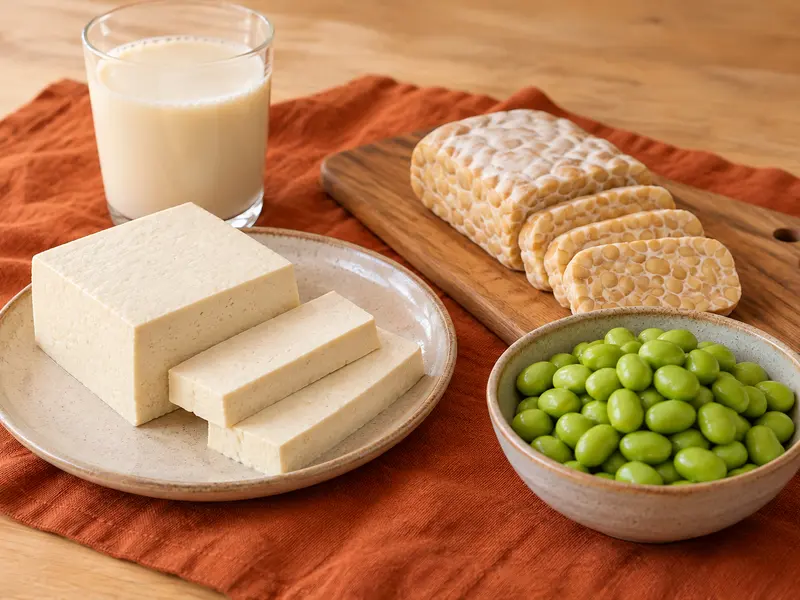
Tofu, tempeh, edamame and soy milk can be useful protein foods. Human research does not support a blanket warning that ordinary soy foods lower testosterone or act like hormone therapy. Soy protein can modestly lower LDL cholesterol when it replaces other proteins. The details depend on the product and the person: soy allergy, thyroid medicine and concentrated isoflavone supplements deserve separate attention. [2][3][4][6][9]
Begin with the food you plan to eat
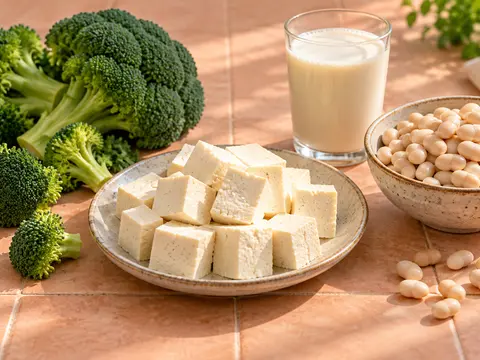
Tofu, tempeh, edamame and unsweetened soy milk can provide protein in vegan meals. They also differ in texture, water content, fortification and sodium. Soy sauce is mainly a seasoning, and an isoflavone capsule is a concentrated supplement. A claim about one of these products cannot automatically be applied to all of them. MedlinePlus explains the product differences.
Isoflavones are compounds naturally present in soybeans. Their structure lets them interact with estrogen receptors, which is why they are often called phytoestrogens. They are not identical to the hormone estrogen. Laboratory receptor activity can suggest questions for human research; it cannot, by itself, tell us what a tofu meal will do to someone’s hormones or disease risk. A review of human trials in postmenopausal women examines that distinction.
For most adults, ordinary soy foods are a reasonable option among beans, lentils, nuts and other plant proteins. Choosing soy does not require taking an extract, eating it at every meal or treating it as medicine.
The cholesterol effect is modest
A meta-analysis examined studies selected for an FDA review of soy protein. Of 46 identified trials, 43 supplied usable data, involving 2,607 adults; 41 supplied LDL cholesterol data. At a median intake of 25 grams of soy protein daily over a median six weeks, LDL was about 4.8 mg/dL lower than with non-soy protein. The 95% confidence interval was a reduction of about 2.8–6.7 mg/dL. Blanco Mejia and colleagues report the analysis.
That is a small average reduction. Results varied between studies, most used isolated soy protein, and many compared it with dairy protein. The studies assessed cholesterol rather than heart attacks. Twenty-five grams refers to soy protein, not 25 grams of tofu, and the median study intake is not a daily requirement.
The replacement also matters. A tofu dish that replaces a food high in saturated fat changes the diet in several ways. Adding a soy dessert to an otherwise unchanged diet is a different intervention. NIH’s soy guidance describes a small cholesterol benefit from replacing other proteins with soy protein, while distinguishing that evidence from isoflavone supplements.
Human studies do not support a simple testosterone warning
A 2021 review combined 41 clinical studies of soy foods, protein preparations and isoflavone extracts. Total testosterone had been measured in 1,753 men across those studies. The review found no statistically clear average effect on total or free testosterone, estradiol, estrone or sex hormone-binding globulin. It included controlled comparisons and separate analyses of changes within treatment groups; the entire evidence base was not 41 identical randomized trials. Reed and colleagues’ paper provides the details.
A newer review restricted to healthy men also found no clear overall testosterone effect. It reported estradiol increases in some subgroups and nonlinear dose-related signals for estradiol and sex hormone-binding globulin. Those analyses used small numbers of studies, with wide uncertainty at higher doses. The overall estradiol comparison was not statistically clear. Rajaie and colleagues identify the limits themselves.
These findings leave room for further research, especially on concentrated products and particular populations. They do not establish that usual portions of tofu lower testosterone or produce clinically meaningful feminizing effects. Hormone concentrations also do not answer every question about fertility, symptoms or sexual function. A person with symptoms needs assessment rather than a diagnosis based on whether they eat soy.
Findings in women depend on the outcome measured
A separate review included 40 randomized trials involving 3,285 postmenopausal women. Compared with controls without isoflavones, soy isoflavones produced no statistically clear average change in estradiol, follicle-stimulating hormone, endometrial thickness or vaginal maturation. The authors rated evidence for the two blood measures more certain than for the tissue measures. Viscardi and colleagues report the review.
Many included trials used supplements, and follow-up was generally measured in months. The findings concern four particular measurements in postmenopausal women. They do not establish that soy has no biological effects, that every supplement is safe indefinitely, or that results apply identically to younger adults. A useful conclusion is that soy isoflavones should not be assumed to reproduce the effects of hormone therapy.
Some of the prominent soy reviews have soy-industry funding or authors with soy-industry relationships. Those interests deserve disclosure alongside scrutiny of the methods, comparison groups and consistency of results. They are one reason to consider the full evidence rather than a single reassuring or alarming headline.
Soy foods and breast cancer concerns
The American Cancer Society states that eating soy foods does not appear to increase breast cancer recurrence risk. Its advice distinguishes foods from soy or isoflavone supplements, for which the evidence is less clear. See its survivorship guidance.
Observational studies sometimes associate higher soy intake with better outcomes. People who eat more soy can differ in other habits, and these associations do not prove that adding soy treats cancer. The hormone-marker trials above cannot establish that claim either. Anyone receiving cancer treatment should discuss supplements and individual dietary restrictions with their care team; ordinary food questions and concentrated supplement decisions should be discussed separately.
Thyroid disease and medicines need individual attention
A review of 18 trials found no clear average change in the thyroid hormones free T3 and free T4, but a small rise in thyroid-stimulating hormone, or TSH. The clinical importance was uncertain. Many interventions used supplements, and people with existing thyroid impairment may respond differently from healthy adults. Otun and colleagues report both the findings and the limitations.
Soy can also affect absorption of levothyroxine. That is a medication-management issue even when soy has not damaged the thyroid gland. Tell the prescriber or pharmacist about a substantial change in soy intake and follow the instructions for your own medicine. Do not adjust or stop treatment yourself. NIH’s thyroid information describes the absorption concern.
Soy allergy is a separate, established reason to avoid soy. Read ingredient and allergen labels if you have a diagnosed allergy. Soy can also cause digestive symptoms in some people. NIH’s soy fact sheet covers these practical cautions.
Choose soy for what it contributes to a meal
Check protein per serving rather than assuming every soy product supplies the same amount. For soy milk, check calcium, vitamin D and B12 fortification individually. Tofu’s calcium depends partly on how it is made, and the label matters more than its name. These checks are especially useful when replacing a food that supplied those nutrients.
Plain tofu can go into a stir-fry or scramble; tempeh works in a tomato sauce; shelled edamame can join noodles or a grain bowl. Peanut tofu broccoli noodles and tempeh tomato pasta show two ways to build a meal around soy. Check the recipe’s required ingredients and your package label when estimating protein.
You can also eat a balanced plant-based diet without soy. Beans, lentils, chickpeas and other foods offer alternatives if you dislike it or need to avoid it. Our plant protein guide explains how these choices fit the wider diet.
Sources and further reading
- MedlinePlus. Soy. US National Library of Medicine; n.d.
- National Center for Complementary and Integrative Health. Soy. National Institutes of Health; 2025.
- Blanco Mejia S et al.. A Meta-Analysis of 46 Studies Identified by the FDA Demonstrates that Soy Protein Decreases Circulating LDL and Total Cholesterol Concentrations in Adults. The Journal of Nutrition; 2019. DOI: 10.1093/jn/nxz020.
- Reed KE, Camargo J, Hamilton-Reeves J, Kurzer M, Messina M. Neither soy nor isoflavone intake affects male reproductive hormones: An expanded and updated meta-analysis of clinical studies. Reproductive Toxicology; 2021. DOI: 10.1016/j.reprotox.2020.12.019.
- Rajaie SH, Mohseni-Takalloo S, Sadeghi O, Hashempur MH. The Impact of Soy Products and Isoflavones on Male Reproductive Hormones: A Systematic Review and Dose–Response Meta-Analysis of Randomized Controlled Trials. Food Frontiers; 2025. DOI: 10.1002/fft2.70090.
- Viscardi G et al.. Effect of Soy Isoflavones on Measures of Estrogenicity: A Systematic Review and Meta-Analysis of Randomized Controlled Trials. Advances in Nutrition; 2025. DOI: 10.1016/j.advnut.2024.100327.
- American Cancer Society. Can I Lower My Risk of Breast Cancer Returning or Progressing?. American Cancer Society; n.d.
- Otun J, Sahebkar A, Östlundh L, Atkin SL, Sathyapalan T. Systematic Review and Meta-analysis on the Effect of Soy on Thyroid Function. Scientific Reports; 2019. DOI: 10.1038/s41598-019-40647-x.
- National Institutes of Health. Thyroid Disease. NIH Health Information; n.d.
Source: https://lentilogical.com/blog/soy-foods-health/
Related guides
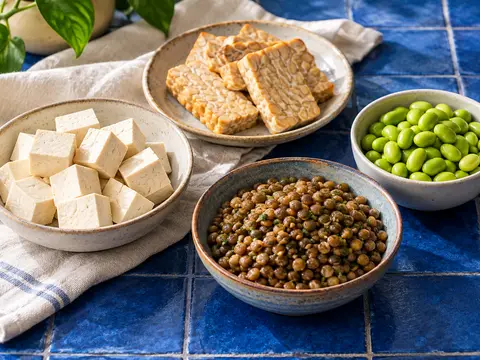
How much protein do you need on a plant-based diet?
Calculate adult protein needs, compare realistic vegan portions, and learn how age, training and protein quality can change the planning.
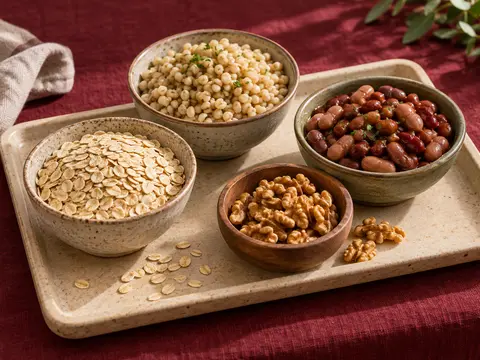
Can a plant-based diet lower LDL cholesterol?
See how much plant-based diets lower LDL in trials, why saturated fat and soluble fibre matter, and how comparison diets affect the results.
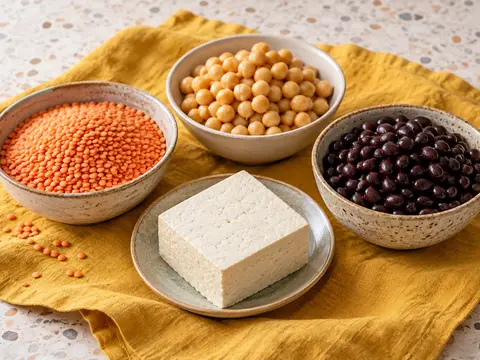
Affordable plant proteins compared
Compare lentils, beans, tofu and other vegan proteins by portion cost and cost per 25 grams of protein, using separate US and Canadian estimates.
Calcium and vitamin D without dairy
Find vegan calcium and vitamin D sources, compare fortified-food labels and portions, and understand when supplements may fill a gap.