Calcium and vitamin D without dairy
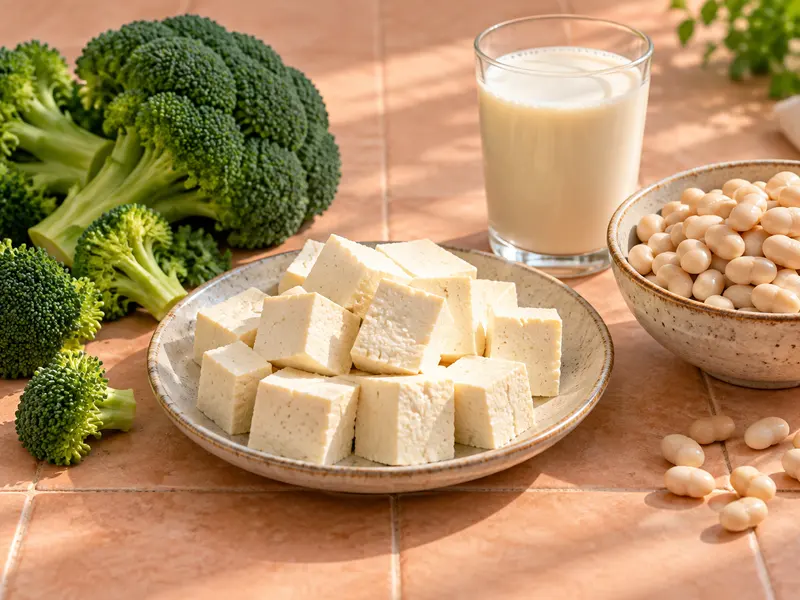
Calcium and vitamin D can be obtained without dairy, but each needs its own plan. Fortified plant beverages, calcium-set tofu and some greens contribute calcium; fortified foods and vegan supplements can provide vitamin D. Check the label and the portion you actually use. Meeting nutrient needs supports bone health, while extra supplements do not automatically prevent fractures in an otherwise well-nourished adult. [1][2][3][5][7]
Plan calcium and vitamin D separately
Calcium supplies part of the structure of bones and teeth. Vitamin D helps the body absorb calcium and maintain normal bone mineralization. A food can supply one nutrient without much of the other, so a single dairy replacement does not settle both questions.
Start with regular foods, their labels and actual portions. A fortified soy beverage, calcium-set tofu and low-oxalate greens can contribute useful calcium. Vitamin D is available in some fortified foods and vegan supplements, but an unfortified plant diet offers relatively few dependable sources. NIH’s vitamin D guidance explains the relationship between the two nutrients.
Use the adult intake that applies
The US and Canadian calcium recommendations refer to the daily total from food and any supplements. HealthLink BC’s current table gives these adult amounts:
| Adult group | Calcium per day |
|---|---|
| Ages 19–50 | 1,000 mg |
| Men ages 51–70 | 1,000 mg |
| Women ages 51–70 | 1,200 mg |
| Adults over 70 | 1,200 mg |
For vitamin D, the US and Canadian RDA is 15 mcg, or 600 IU, daily through age 70, and 20 mcg, or 800 IU, after 70. One microgram of vitamin D equals 40 IU. The Health Canada vitamin table sets these total-intake values assuming minimal sun exposure.
An RDA is a planning value for healthy people. It is not a supplement prescription, a blood-test target or a treatment dose. Someone with osteoporosis, malabsorption, kidney disease or a diagnosed deficiency may need a separate clinical plan.
Fortification makes the label decisive
Fortified and unfortified versions of the same type of plant drink can have very different calcium and vitamin D contents. Organic status, price and a dairy-free claim do not establish the nutrient amounts. Check the Nutrition Facts information for each nutrient.
The serving size matters just as much. If a beverage lists 300 mg calcium per 250 mL, a 125 mL portion provides 150 mg. A splash in coffee supplies much less than a glass. This is a hypothetical label calculation; use the numbers on the product you buy.
Some plant yogurts and cheeses are fortified, but others contain little calcium. Tofu also varies. Calcium sulfate in the ingredients indicates a calcium-containing setting agent; tofu made with a different coagulant may supply much less. The NIH calcium fact sheet distinguishes calcium-set tofu from other tofu.
Follow the container’s directions for shaking or stirring. Count what is served, including the amount used in a recipe divided among its portions. A carton used to make four breakfasts does not supply a carton to each breakfast.
Compare foods by a defined portion
The values below are approximate examples from the NIH food table. Brand and preparation differences matter, especially for fortified beverages and tofu.
| Vegan food | Portion in the source table | Approximate calcium |
|---|---|---|
| Calcium-fortified soy beverage | 1 US cup | 300 mg |
| Firm tofu made with calcium sulfate | 1/2 US cup | 250 mg |
| Cooked kale | 1 US cup | 95 mg |
| Raw shredded bok choy | 1 US cup | 75 mg |
| Chia seeds | 1 tablespoon | 75 mg |
Two full portions of the example beverage provide about 600 mg; the example tofu adds about 250 mg. Other foods still need to contribute toward a 1,000 mg day. This arithmetic is not a complete menu, and it should not be applied to an unfortified beverage or an unidentified tofu product.
Greens add variety, but the portion and amount explain why relying entirely on greens can be difficult. One cup of cooked kale and one cup of loosely packed raw leaves are not the same amount of food. A pinch of seeds also provides much less calcium than the defined spoonful.
Absorption differs among greens
Calcium on a composition table is not identical to calcium absorbed. Spinach contains calcium, but its oxalate binds much of it. Kale, broccoli and bok choy provide calcium that is more readily available. This makes spinach a poor main calcium source even though it remains a useful vegetable. NIH reviews these absorption differences.
There is no need to calculate an absorbed milligram total for each meal. Dietary recommendations already incorporate assumptions about ordinary absorption. Use several dependable calcium foods and check a typical day’s portions rather than trying to derive a personal absorption percentage from a table.
For an ordinary meal, tofu scramble with potatoes can use calcium-set tofu, while a stir-fry can include bok choy. The calcium contribution still depends on the product and the recipe portion. Choosing a recipe title with tofu in it is not enough to establish a calcium amount.
Sunlight is not a dependable intake measure
The skin can make vitamin D, but latitude, season, time outdoors, age and other factors affect production. A fixed number of minutes outdoors is not a reliable universal prescription. Health Canada’s vitamin D advice recommends a daily food or supplement source instead of relying on that uncertainty.
For Canadian adults aged 51 and older, Health Canada recommends a daily supplement containing 400 IU, or 10 mcg. Younger adults are advised to eat vitamin D foods daily or take that supplement amount. The 400 IU advice describes supplementation within a public-health plan; it does not replace the total RDA of 600 or 800 IU.
Look for vitamin D on fortified plant beverages, cereals and other labelled foods. Some mushrooms exposed to ultraviolet light provide vitamin D, but an ordinary mushroom portion cannot be assumed to have the same content. The product information should establish the source and amount.
A vegan supplement needs a source check
Vitamin D2 and D3 can both raise vitamin D status. D3 is often made from sheep’s wool lanolin, while animal-free D3 from lichen is available. D2 is commonly produced from yeast. Check the full product, including the capsule, for vegan ingredients. NIH describes these sources.
More vitamin D is not automatically better. The Endocrine Society’s prevention guideline advises generally healthy adults under 75 to meet the established dietary reference intake, rather than routinely supplementing above it to prevent disease. It also advises against routine vitamin D testing in generally healthy adults without another indication. Its recommendations differ for some groups, including adults aged 75 and older.
A clinician may recommend testing or treatment for a specific reason. That is a different situation from buying a high-dose supplement after seeing a general claim about bone health.
Nutrient adequacy and fracture prevention are different outcomes
Getting enough calcium and vitamin D is necessary for normal bone health. It does not follow that extra supplements prevent fractures in every well-nourished adult. In the VITAL randomized trial, vitamin D supplementation did not reduce fractures among generally healthy midlife and older adults who had not been selected for deficiency or osteoporosis. This finding does not show that treating deficiency is unnecessary.
Vegan diets also should not be assumed to protect bones automatically. The EPIC-Oxford cohort found higher hip-fracture rates among vegans than meat eaters. This was an association, not a randomized diet trial. Adjustment for body mass index and reported calcium and protein intake partly attenuated the association, but the study could not establish that a calcium or vitamin D supplement would remove the difference.
Bone health involves food intake, muscle strength, activity, falls, medications and other factors. A nutrient calculation answers an intake question, not a person’s entire fracture risk.
Use a supplement to address a remaining gap
If regular food portions leave calcium short, a supplement can contribute the difference. HealthLink BC recommends reviewing food intake first and discussing the type and amount with a dietitian, pharmacist or other health professional when needed.
Keep food, fortified products and supplements in one total. Calcium supplements can interact with some medicines, and vitamin D excess can be harmful. Bring the product labels to a pharmacist rather than changing a medicine schedule yourself.
The supplement decision guide places these choices alongside B12, iodine, iron, zinc and omega-3. A manageable plan has a named source for each nutrient and portions that fit the way you eat.
Sources and further reading
- HealthLink BC. Calcium and your health. HealthLinkBC File 68e; 2026.
- NIH Office of Dietary Supplements. Calcium: Fact Sheet for Health Professionals. National Institutes of Health; 2026.
- NIH Office of Dietary Supplements. Vitamin D: Fact Sheet for Health Professionals. National Institutes of Health; 2025.
- Health Canada. Dietary reference intakes tables: Reference values for vitamins. Canada.ca; 2025.
- Health Canada. Vitamin D. Canada.ca; 2022.
- Demay MB, Pittas AG, Bikle DD, et al.; Endocrine Society. Vitamin D for the Prevention of Disease: An Endocrine Society Clinical Practice Guideline. Journal of Clinical Endocrinology & Metabolism; guideline resources; 2024.
- LeBoff MS, Chou SH, Ratliff KA, et al.. Supplemental Vitamin D and Incident Fractures in Midlife and Older Adults. New England Journal of Medicine; 2022. DOI: 10.1056/NEJMoa2202106.
- Tong TYN, Appleby PN, Armstrong MEG, et al.. Vegetarian and vegan diets and risks of total and site-specific fractures: results from the prospective EPIC-Oxford study. BMC Medicine; 2020. DOI: 10.1186/s12916-020-01815-3.
Source: https://lentilogical.com/blog/vegan-calcium-vitamin-d/
Related guides
Which supplements might a vegan diet need?
Review B12, vitamin D, iodine, calcium, iron, zinc and omega-3 with a practical guide to food gaps, supplement labels and professional advice.
How much protein do you need on a plant-based diet?
Calculate adult protein needs, compare realistic vegan portions, and learn how age, training and protein quality can change the planning.
Vitamin B12 on a vegan diet
Find reliable vegan B12 sources, read fortified-food labels, and understand how dietary needs, preventive supplement schedules and treatment differ.