Omega-3 on a vegan diet: seeds and algae
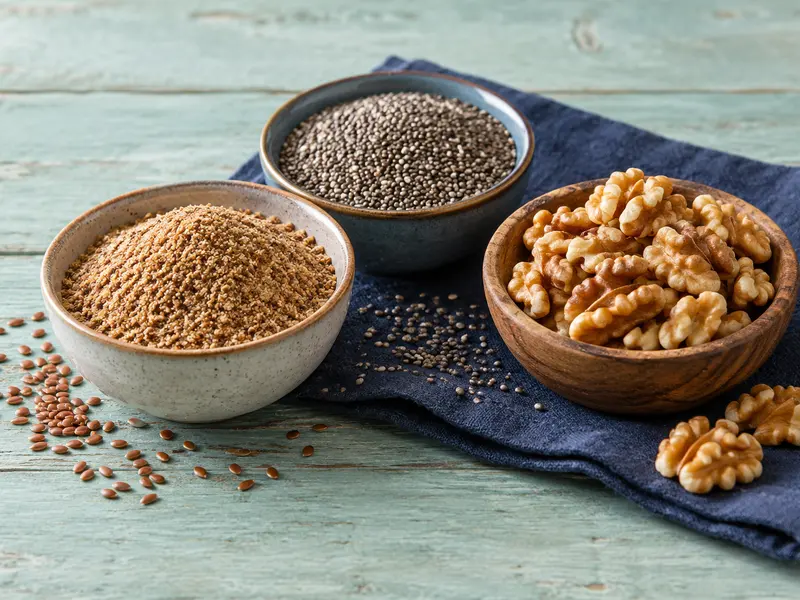
A vegan diet can supply essential omega-3 ALA through foods such as flaxseed, chia, walnuts and canola oil. Algal oil supplies DHA, and some products also contain EPA. The body converts some ALA into these longer-chain fats, but the amount is limited and variable. Algae supplements can raise blood DHA; that does not establish that every vegan needs the same dose or that taking one will prevent disease. [1][3]
ALA, EPA and DHA do different jobs
Omega-3 is the name of a family of fats. Alpha-linolenic acid, or ALA, is an essential fatty acid: food must supply it. Eicosapentaenoic acid (EPA) and docosahexaenoic acid (DHA) are longer-chain omega-3s. The body can make them from ALA, but conversion is limited and varies between people. A gram of ALA therefore cannot be counted as a gram of EPA or DHA. NIH explains the distinctions.
Seeds and their oils mainly provide ALA. Algal oil can supply DHA, and some products also supply EPA. This gives vegan eaters two separate questions to answer: how to obtain enough ALA from food, and whether to add a direct source of the longer-chain fats.
Neither question is answered by a front label that says only “omega-3.” Check which fatty acid the product contains. Flax oil and algal oil can both carry that wording while supplying quite different fats.
Start with a regular food source of ALA
The adult adequate intake used in US and Canadian dietary reference values is 1.6 grams of ALA per day for men and 1.1 grams for women. These are the categories in the reference tables. An adequate intake is a planning reference established when evidence is insufficient to set a recommended dietary allowance; it is not a test that diagnoses deficiency in an individual. Health Canada’s macronutrient table lists the values.
Chia seeds, flaxseed, walnuts, and canola or soybean oil can contribute ALA. NIH’s food table lists approximately 5.1 grams in an ounce of chia seeds and 2.6 grams in an ounce of walnuts. An ounce is about 28 grams. Those figures describe ALA, with ordinary variation between foods, rather than an EPA-and-DHA dose. See the food-source table.
Choose a source that fits something you already eat: ground flaxseed stirred into oats, chia in a pudding, or walnuts added to a lentil dish. Buying several special ingredients is unnecessary. A food you use regularly is more useful than a large bag that stays in the cupboard.
Keep the rest of the meal in view. Seeds and nuts also add energy, and a seed garnish does not replace the beans or tofu that provide much of a meal’s protein. If the serving is very small, check how much ALA that amount supplies rather than assuming any sprinkling meets the reference intake.
Conversion cannot provide a precise personal allowance
Advice sometimes turns ALA conversion into a neat calculation: eat a fixed amount of flaxseed and assume a fixed amount of DHA will result. Human metabolism is less predictable. Sex, background diet and other individual factors affect the measurements, and studies use different methods to estimate conversion. NIH describes conversion as limited. It does not provide a reliable personal conversion calculator. NIH omega-3 guidance.
Lower blood EPA or DHA in a group of vegans does not by itself establish that every member has a clinical deficiency. Blood concentration, tissue supply and health outcomes are different measurements. This also limits claims that everyone should buy an omega-3 blood test or aim for a particular commercial “optimal” result.
An algal supplement avoids depending entirely on conversion for the fatty acid it supplies. It still does not remove the need for ALA-containing foods.
What algae supplements have actually been shown to do
In a Spanish crossover trial, 116 adults were randomized and 98 completed the study. Participants included vegans, lacto-ovo vegetarians and omnivores. They took 250 milligrams of algal DHA daily or an olive-oil placebo for five weeks, then crossed over after a five-week washout. Serum DHA rose with the supplement in all three diet groups. García-Maldonado and colleagues’ full trial reports the methods and results.
That is evidence that this algal DHA was absorbed. The researchers did not test memory, vision, heart attacks or longevity. The study measured serum fatty acids, rather than tissue concentrations, and enrolled mainly young, healthy adults. A laboratory, government and research-institute partnership funded it, including the supplement manufacturer.
There is also a distinction between a studied dose and a universal requirement. The European Food Safety Authority sets an adult adequate intake of 250 milligrams per day of EPA plus DHA. The US/Canadian reference system has no separate adult recommended dietary allowance for EPA or DHA. These are different guidance frameworks, not competing measurements of what one individual needs. EFSA’s dietary reference opinion explains its basis.
For an adult considering a direct vegan source, an algal product with clearly stated DHA and EPA amounts offers a way to obtain those fats. A dietitian can help weigh that choice against diet, health circumstances and cost. The 250-milligram DHA trial does not establish the best dose for every adult.
A higher blood level does not guarantee better memory
Claims about “brain health” often skip the step between a nutrient’s biological role and a benefit from taking extra. A recent randomized trial illustrates the gap. It assigned 365 adults aged 55–80 with low DHA intake and at least one dementia risk factor to high-dose DHA or placebo for two years. DHA increased a marker in cerebrospinal fluid, but there was no demonstrated advantage in cognitive performance or brain-volume outcomes. Yassine and colleagues report the trial.
The study had substantial dropout, much of it associated with the pandemic, and participants had relatively preserved cognition. It cannot settle every question about DHA throughout life. It does show why improved fatty-acid measurements should not be advertised as proven dementia prevention. It was not a trial of ordinary ALA-rich foods or a general vegan diet.
Read the back of the supplement bottle
Compare the amount of DHA and EPA in the stated daily serving, the number of capsules needed, and the cost of that serving. A large amount of “algal oil” is not the same as that amount of DHA. Check the capsule shell and other ingredients if you avoid all animal products. A DHA-only product and an EPA-and-DHA product are different formulations.
US dietary supplements do not receive FDA approval for safety and effectiveness before sale. A quality or testing claim should describe what was checked; it cannot establish that a product prevents disease. FDA’s supplement questions and answers explains the regulatory distinction.
In Canada, look for the eight-digit Natural Product Number and check the product’s authorized directions and cautions in the Licensed Natural Health Products Database.
Discuss supplements with a clinician or pharmacist if you take anticoagulants, have a relevant medical condition, or are considering high doses. Prescription omega-3 treatment for very high triglycerides is a separate medical decision. For everyday meal planning, establish an ALA food habit first, then make an informed choice about a direct algal source. Our vegan supplement guide puts that decision alongside B12 and other nutrients.
Sources and further reading
- NIH Office of Dietary Supplements. Omega-3 Fatty Acids: Fact Sheet for Health Professionals. National Institutes of Health; 2025.
- Health Canada. Dietary reference intakes tables: Reference values for macronutrients. Government of Canada; 2025.
- García-Maldonado E, Alcorta A, Zapatera B, Vaquero MP. Changes in fatty acid levels after consumption of a novel docosahexaenoic supplement from algae: a crossover randomized controlled trial in omnivorous, lacto-ovo vegetarians and vegans. European Journal of Nutrition; 2023. DOI: 10.1007/s00394-022-03050-3.
- EFSA Panel on Dietetic Products, Nutrition, and Allergies. Scientific Opinion on Dietary Reference Values for fats, including saturated fatty acids, polyunsaturated fatty acids, monounsaturated fatty acids, trans fatty acids, and cholesterol. EFSA Journal; 2010. DOI: 10.2903/j.efsa.2010.1461.
- Yassine HN et al.. CNS target engagement of high-dose DHA supplementation in older adults at risk for dementia: a randomised, double-blind, placebo-controlled trial. eBioMedicine; 2026. DOI: 10.1016/j.ebiom.2026.106316.
- US Food and Drug Administration. Questions and Answers on Dietary Supplements. FDA; 2026.
- Health Canada. Licensed Natural Health Products Database. Government of Canada; n.d.
Source: https://lentilogical.com/blog/vegan-omega-3/
Related guides

Which supplements might a vegan diet need?
Review B12, vitamin D, iodine, calcium, iron, zinc and omega-3 with a practical guide to food gaps, supplement labels and professional advice.
How much protein do you need on a plant-based diet?
Calculate adult protein needs, compare realistic vegan portions, and learn how age, training and protein quality can change the planning.
Soy foods and health: what human studies show
What tofu, tempeh and soy milk contribute to a vegan diet, with human evidence on cholesterol, hormones and thyroid concerns, plus supplement cautions.