How to get zinc on a vegan diet
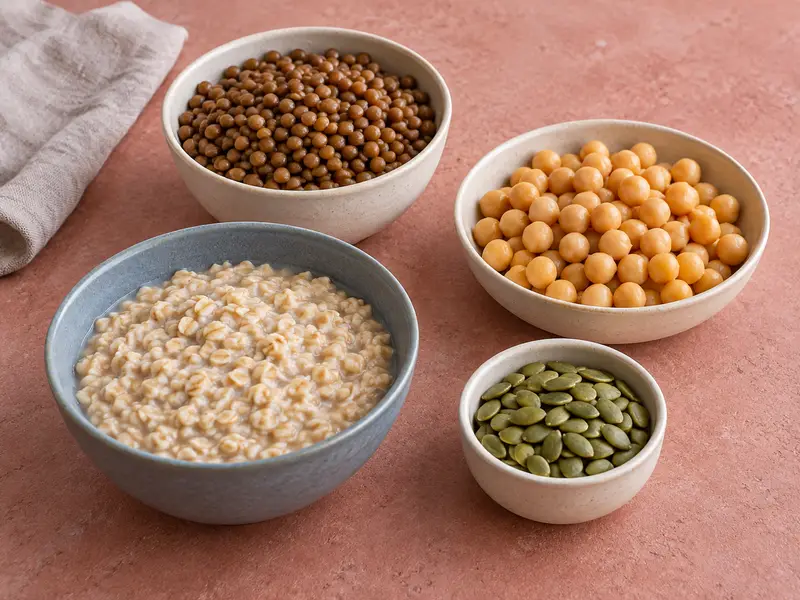
Beans, lentils, seeds and whole grains can supply zinc on a vegan diet, with fortified foods or supplements sometimes filling gaps. Portion size and absorption matter. Phytate in plant foods can reduce zinc availability, so a food’s zinc content is not a direct measure of what your body absorbs. This guide covers healthy adults aged 19 and older; individual medical needs require a separate review. [1][2]
Start with the adult reference intakes
Zinc supports enzymes, protein and DNA synthesis, immune function and wound healing. A useful plan supplies it regularly without treating a large dose as a general health upgrade. The Health Canada reference table gives these recommended dietary allowances, consistent with the US values:
| Life stage, age 19 and older | Zinc RDA, total daily intake |
|---|---|
| Adult men | 11 mg |
| Adult women who are not pregnant or lactating | 8 mg |
| Pregnancy | 11 mg |
| Lactation | 12 mg |
These references describe habitual intake for generally healthy people. A day below an RDA is not a diagnosis of deficiency. Food, fortified products and supplements all count toward intake. The adult upper intake level is 40 mg daily from food and supplements; it is a safety boundary, not a target or a suggested tablet strength. Adolescents have different values, including a lower upper limit.
The Canadian table also notes that vegetarian zinc requirements may be up to 50% higher, particularly where grains and legumes are staples. That conditional allowance reflects lower bioavailability in some diets. It does not establish one supplement dose for every vegan or let a food diary calculate exactly how much zinc a person absorbs. The broader supplement guide can help put zinc alongside other nutrients that need review.
Use food portions you can recognize
These examples come from the USDA SR Legacy dataset. They show zinc present in generic foods, rounded to a practical amount:
| Food and preparation | Reference portion | Approximate zinc |
|---|---|---|
| Pumpkin and squash seed kernels, roasted without salt | 1 oz, 28.35 g | 2.2 mg |
| Lentils, boiled without salt | 1 cup cooked, 198 g | 2.5 mg |
| Chickpeas, boiled without salt | 1 cup cooked, 164 g | 2.5 mg |
| Regular or quick oatmeal, unenriched, cooked with water without salt | 1 cup cooked, 234 g | 2.3 mg |
These are historical US composition references, not current brand labels or Canadian laboratory measurements. The cup measures belong to the stated USDA portions; the gram weights help you compare actual amounts. Keep cooked and dry weights separate. A bowl of oatmeal made from a measured dry quantity changes weight as it takes up water.
Pumpkin kernels mean the edible green seeds, with shells removed. The legume entries describe boiled foods, so their numbers do not identify a particular canned product. Check a product label or a matching food record when the preparation differs.
You do not need to turn those four foods into a rigid daily menu. Use the portions to notice which foods are actually contributing and where a routine is narrow. A small sprinkle of seeds provides less than the full ounce in the table. Our bean and chickpea collection offers ways to use legumes in meals across the week.
Prepare beans and grains with absorption in mind
Phytate is a natural component of plant foods that can bind zinc in the intestine. A diet can contain zinc while allowing a smaller fraction to be absorbed. The amount absorbed depends on the diet and the person; a table of milligrams alone cannot resolve that question.
The NIH zinc guidance describes soaking before cooking, canned or precooked foods, and fermented foods as possible ways to improve availability. These are food choices with variable effects. Keep the nutrients and usefulness of beans and grains in view while planning a varied diet.
A laboratory study of soaked whole cereals and legumes found different changes across foods, including zinc losses in some cereals. It measured chemical contents and ratios, not zinc absorption in people. It cannot promise that a particular home soak will deliver a fixed absorption increase. Follow safe preparation and cooking directions for the food you are using; a nutrition experiment is not a home storage protocol.
Read zinc on food labels
Ordinary US food labels use an 11 mg zinc Daily Value. Canada’s ordinary-food reference is also 11 mg. This shared label reference differs from the personal RDA table above. Special-purpose labels can use different references.
For an ordinary 11 mg reference, 20% Daily Value corresponds nominally to 2.2 mg zinc per stated serving. This is label arithmetic, not a claim about a particular product. Half that serving supplies half the nominal amount; printed percentages and milligram figures can be rounded. Read the physical serving size before comparing two foods.
A missing zinc line does not mean zero zinc. Under US nutrition-labeling rules and Canadian Nutrition Facts guidance, zinc is generally optional, with rules that can require declaration when nutrient zinc is added or relevant claims are made. If a food is meant to supply a substantial part of your zinc plan, seek its amount when the available label does not provide one.
Check zinc separately from calcium or B12 fortification. A product containing one added nutrient does not automatically supply another. Recheck the package when you change brands, country or formulation.
Read blood-test studies with their cutoffs
A German RBVD follow-up published in 2026 followed a small cohort of 24 vegans and 26 omnivores. Its later measurements were collected during July 2021–February 2022. Follow-up median serum zinc was 78 µg/dL in vegans and 85 µg/dL in omnivores. These are blood concentrations, not milligrams eaten per day.
No participant fell below the laboratory’s 60 µg/dL lower boundary at follow-up. Using sex-specific cutoffs of 70 µg/dL for women and 74 µg/dL for men, the authors reported low values in seven vegans and two omnivores. The same data therefore produced different counts under different criteria. The study was observational, had attrition and supplement use, and did not measure zinc absorption or establish a zinc-related clinical illness. Overall cohort counts also do not mean every laboratory result was available for every participant.
The NIH guidance explains that serum zinc varies with factors including blood-draw timing, infection and illness. A clinician considers diet, risk factors and the wider clinical picture when interpreting results. A lower group average or a nonspecific symptom cannot diagnose an individual from an article.
Check the whole supplement routine
Start with the amount of zinc on the Supplement Facts panel. In the US, that amount is elemental zinc, not the weight of the entire zinc compound. The serving may be more than one tablet. Include any zinc from a multivitamin, separate mineral product or cold remedy when reviewing your total.
The NIH safety discussion notes that taking 50 mg or more for weeks can interfere with copper absorption and cause other problems. The adult upper limit remains 40 mg total daily intake; the 50 mg observation does not define a recommended dose or make the amounts in between a safe long-term plan. Medical treatment can differ from ordinary intake limits and needs appropriate supervision.
Zinc can interact with certain antibiotics and penicillamine, while some diuretics affect zinc loss. Ask a pharmacist or prescriber to check the exact product, amount and timing alongside your medicines. Do not add copper simply to compensate for an unsupervised high zinc dose.
People with limited food intake, digestive conditions affecting absorption, persistent symptoms or an abnormal result need individual assessment. Pregnancy and lactation also merit a separate nutrition review. The German adult study does not answer those clinical situations.
Keep the plan workable on a budget
Review foods already in your kitchen and the amounts you actually eat. A cooked cup of legumes and a seed garnish are different contributions; compare your portion with a matching preparation in the table. Check several usual days so a single unusually large meal does not stand in for the whole routine.
When comparing dry and canned legumes, consider the cooked yield, preparation time and likely waste. A large package is useful when you will use and store it well. The food-budget and storage guide offers practical ways to plan portions and leftovers. Our protein-cost guide can help with the meal budget while zinc remains its own nutrient check.
Keep any unknown zinc amount marked as unknown. If the routine has few dependable sources, take a short food record and the actual product labels to a dietitian or clinician. That review can address whether food changes, fortified products or a supplement fill a defined gap without treating a larger bottle or dose as proof of adequacy.
Sources and further reading
- National Institutes of Health, Office of Dietary Supplements. Zinc: Fact Sheet for Health Professionals. National Institutes of Health; 2026.
- Health Canada. Dietary reference intakes tables: Reference values for elements. Health Canada; 2025.
- US Department of Agriculture, Agricultural Research Service. FoodData Central SR Legacy, April 2018 CSV dataset. US Department of Agriculture; 2018.
- US Food and Drug Administration. Daily Value on the Nutrition and Supplement Facts Labels. US Food and Drug Administration; n.d.
- Health Canada. Nutrition labelling: Table of daily values. Health Canada; 2022.
- US Food and Drug Administration. 21 CFR 101.9: Nutrition labeling of food. Electronic Code of Federal Regulations; 2026.
- Canadian Food Inspection Agency. Information within the Nutrition Facts table. Canadian Food Inspection Agency; 2026.
- Isabelle Lestienne; Christèle Icard-Vernière; Claire Mouquet; Christian Picq; Serge Trèche. Effects of soaking whole cereal and legume seeds on iron, zinc and phytate contents. Food Chemistry; 2005. DOI: 10.1016/j.foodchem.2004.03.040.
- Katharina J. Penczynski and colleagues. Nutrition and health status in the follow-up of the risks and benefits of a vegan diet (RBVD) study. Scientific Reports; 2026. DOI: 10.1038/s41598-026-72290-8.
Source: https://lentilogical.com/blog/vegan-zinc/
Related guides
Which supplements might a vegan diet need?
Review B12, vitamin D, iodine, calcium, iron, zinc and omega-3 with a practical guide to food gaps, supplement labels and professional advice.
Getting enough iron from plant foods
Compare vegan iron foods and portions, use vitamin C to support absorption, and learn why low iron stores or symptoms need assessment.
Affordable plant proteins compared
Compare lentils, beans, tofu and other vegan proteins by portion cost and cost per 25 grams of protein, using separate US and Canadian estimates.