Fibre, beans and gut health
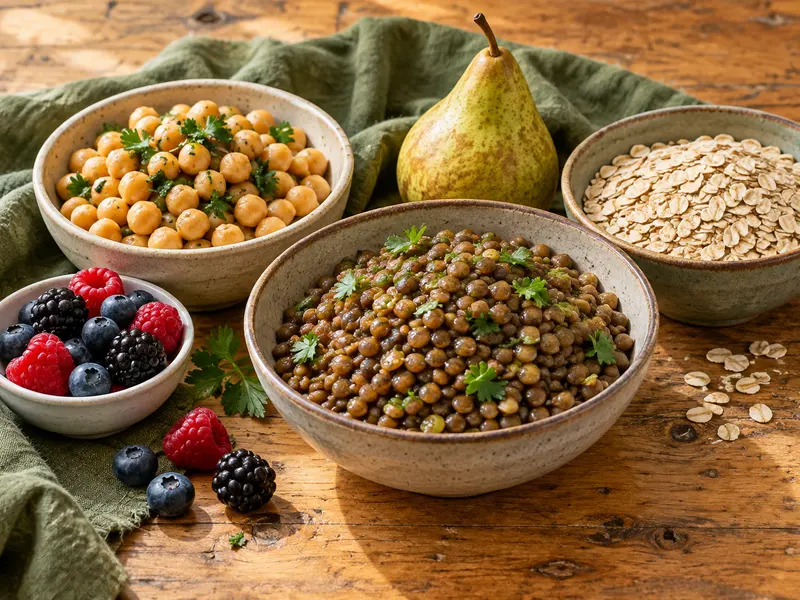
Beans, whole grains, vegetables, fruit, nuts and seeds can help you get enough fibre and support regular bowel movements. Increase intake gradually, especially if you currently eat little fibre or have digestive symptoms. Food can change gut microbes and their activity, but those changes alone do not establish better health or protection from disease. The useful goal is a varied diet you can eat comfortably. [2][5][6]
Different fibres have different effects
“Fibre” covers several substances with different properties. Soluble fibre occurs in foods such as beans, fruit and oats; insoluble fibre occurs in whole grains and vegetables. Foods contain mixtures, so this distinction does not divide meals into two exclusive categories. For people with irritable bowel syndrome, research generally supports soluble fibre more than insoluble fibre for symptom relief. That does not mean every food containing soluble fibre will suit every person with IBS. NIDDK guidance
Enough fibre and appropriate fluid intake can help make stools softer and easier to pass. A diet built around oats, lentils, beans, fruit and vegetables offers several ways to get fibre without relying on one ingredient. NIDDK recommends adding it a little at a time and adjusting fluid intake to your health and circumstances. If you have a prescribed fluid restriction, ask your care team how to approach this. Constipation guidance
Use an intake target as a guide
WHO recommends that adults get at least 25 grams a day of naturally occurring fibre from foods, with carbohydrates coming primarily from whole grains, vegetables, fruit and pulses. This is general population guidance, not a treatment dose or a target everyone should reach overnight. Individual needs and digestive conditions can affect the plan. WHO carbohydrate guideline
Start by looking at the foods you eat regularly. A vegan menu can still contain little fibre if most meals revolve around refined grains and oils. Conversely, adding a modest portion of beans to a familiar meal can be easier than rebuilding the whole menu.
These are meal options rather than a prescribed daily plan:
| Meal | A way to include fibre |
|---|---|
| Breakfast | Oatmeal with fruit and a spoonful of nuts or seeds |
| Lunch | A sandwich with chickpea filling, or soup with beans |
| Dinner | Lentils alongside rice, pasta or potatoes and vegetables |
| Snack | Fruit or a small portion of nuts |
Use package labels to compare foods you actually buy. Portions and recipes vary, so a meal’s name alone does not tell you its fibre content.
Constipation needs a more specific question
If you are constipated, the relevant question is which change improves your symptoms. The 2025 British Dietetic Association guideline found evidence that particular fibre supplements, especially psyllium, can improve treatment response, stool frequency and straining. Evidence certainty was generally low. Other fibres had weaker or absent effects on particular outcomes, and some increased flatulence. A supplement result cannot simply be assigned to any food with the same total fibre grams. BDA guideline
The guideline also identified a shortage of trials of whole high-fibre dietary patterns for treating chronic constipation. That gap does not show those diets are ineffective; it limits how confidently we can promise a particular treatment effect. Persistent constipation deserves assessment and a tailored plan. Increasing fibre indefinitely can leave the original problem unresolved.
What microbiome studies have found
The gut microbiome includes organisms that use food components reaching the large intestine. Diet can change their activity and composition. Whether a particular change improves someone’s health is a further question.
A small Stanford study compared increased plant fibre with increased fermented-food intake during a ten-week dietary intervention. Thirty-six adults were included in the final analyses. In the fibre group, microbial enzymes involved in breaking down complex carbohydrates increased, while microbial diversity did not. The study’s primary immune outcome, a cytokine response score, did not change significantly in either group. Some secondary inflammatory markers fell in the fermented-food group, whose foods included dairy as well as plant ferments. This was not a trial of vegan fermented foods. Wastyk and colleagues
Those results are useful precisely because the outcomes differed. Increased fibre did not automatically produce greater diversity, and a biomarker finding in a small, generally healthy sample does not establish disease prevention.
The BE GONE trial provides a different example. Researchers randomized 55 adults with obesity and a history of colorectal cancer or precancerous polyps to two sequences of beans and their usual diet without beans. Forty-eight completed the study. During the eight-week bean period, participants gradually increased to a cup of navy beans daily. Researchers observed increased microbial diversity and changes in certain microbes and blood metabolites. The study did not establish that beans prevent cancer recurrence or improve survival. BE GONE trial
This was a selected patient group receiving close dietary support. Its serving size is a study intervention, not a requirement for everyone. The research supports further investigation of beans; it does not justify using a stool diversity score as a personal health target.
Gas is variable, and symptoms count
Beans can increase gas, particularly when you start eating them regularly. In three feeding studies, adults ate half a cup daily for eight or twelve weeks. Reports varied by bean type and participant. Many people who reported more gas initially reported less in subsequent weeks, while some continued to have symptoms. These were self-reported experiences, not direct measurements of gas production. Winham and Hutchins
That evidence offers some reassurance without guaranteeing adaptation. Try a few spoonfuls in a meal you already eat, keep other changes modest, and increase the amount if it feels comfortable. You can pause an increase or try another food. Pain is a reason to reconsider the plan, not evidence that it is working.
For diagnosed IBS, some fermentable carbohydrates can provoke symptoms. A clinician or dietitian may suggest a short low-FODMAP trial followed by reintroduction to identify tolerable foods and amounts. NIDDK describes reintroduction as part of the process; permanent avoidance of every food on a restriction list is not the goal. IBS dietary guidance
Make the change small enough to repeat
Choose one regular meal to adjust first. Peanut banana overnight oats offer a breakfast option. If dinner is easier, add a small serving of tomato lentils beside a familiar starch and vegetables. These are ways to use everyday foods, not treatments for IBS or constipation.
A short food-and-symptom note can help you remember what changed: the food, portion, timing and how you felt. Change one major thing at a time so the result is interpretable. If a new meal causes discomfort, look at the portion and other ingredients rather than concluding that all plant foods are unsuitable.
You can also keep preparation simple. Use canned beans when cooking dried beans is impractical, freeze extra cooked lentils, and buy oats or whole-grain bread you enjoy. Variety can develop over several grocery trips. The next useful change may be repeating a comfortable breakfast or trying a smaller bean portion, with persistent symptoms discussed with your health professional.
Sources and further reading
- World Health Organization. Carbohydrate intake for adults and children: WHO guideline. Recommendations and supporting information. World Health Organization; 2023.
- National Institute of Diabetes and Digestive and Kidney Diseases. Eating, Diet, & Nutrition for Constipation. National Institutes of Health; 2018.
- National Institute of Diabetes and Digestive and Kidney Diseases. Eating, Diet, & Nutrition for Irritable Bowel Syndrome. National Institutes of Health; 2017.
- Dimidi E, van der Schoot A, Barrett K, et al.. British Dietetic Association Guidelines for the Dietary Management of Chronic Constipation in Adults. Neurogastroenterology & Motility; 2025. DOI: 10.1111/nmo.70173.
- Wastyk HC, Fragiadakis GK, Perelman D, et al.. Gut-microbiota-targeted diets modulate human immune status. Cell; 2021. DOI: 10.1016/j.cell.2021.06.019.
- Zhang X, Irajizad E, Hoffman KL, et al.. Modulating a prebiotic food source influences inflammation and immune-regulating gut microbes and metabolites: insights from the BE GONE trial. eBioMedicine; 2023. DOI: 10.1016/j.ebiom.2023.104873.
- Winham DM, Hutchins AM. Perceptions of flatulence from bean consumption among adults in 3 feeding studies. Nutrition Journal; 2011. DOI: 10.1186/1475-2891-10-128.
Source: https://lentilogical.com/blog/plant-based-fibre-gut-health/
Related guides
Can a plant-based diet lower LDL cholesterol?
See how much plant-based diets lower LDL in trials, why saturated fat and soluble fibre matter, and how comparison diets affect the results.
Plant-based diets and type 2 diabetes
Separate diabetes-prevention research from treatment trials, understand HbA1c changes, and plan plant-based meals with medication and nutrition in mind.
Eating plant-based on a budget
Plan affordable plant-based meals with a realistic US and Canadian grocery example, including package costs, edible yields and convenience tradeoffs.