Building muscle with plant-based meals
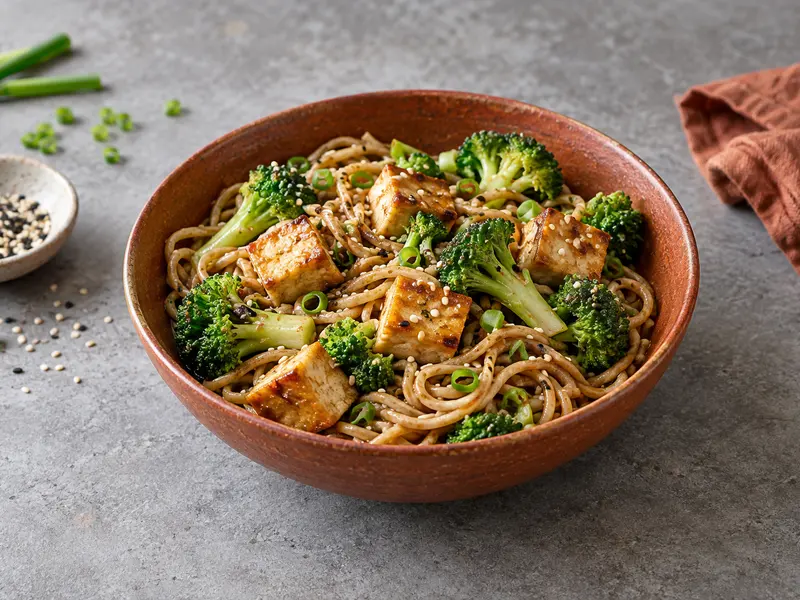
Plant-based meals can support muscle building when resistance training, protein and total food intake are sufficient. A regular portion of tofu, tempeh, legumes or another substantial protein food makes meal planning easier. Trials support useful gains under some vegan eating patterns, but they do not establish that every vegan and omnivorous diet produces identical results. Age, protein source and the amount eaten still matter. [1][2][3][4][7]
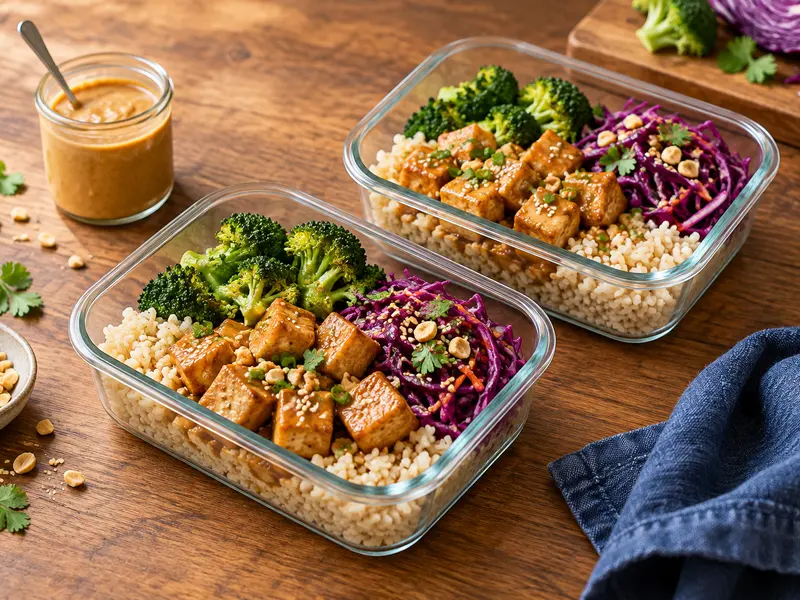
Give the training programme something to build on
Muscle growth needs a repeated training stimulus. A progressive resistance programme makes the muscles work harder over time through changes in load, repetitions or other planned demands. Protein supplies amino acids for the response, and sufficient food energy helps support training and recovery.
The relative size of those contributions is useful. In a review of 49 training trials involving 1,863 healthy adults, adding protein supplements produced an average additional gain in fat-free mass of 0.30 kg, with a 95% confidence interval of 0.09–0.52 kg. Both intervention and comparison groups trained. The estimate describes the supplement’s added contribution across trials, not the total muscle gain someone should expect. Fat-free mass also includes tissues other than muscle.
Choosing the most heavily advertised powder will not compensate for inconsistent training. Conversely, an effective training programme can be harder to sustain if meals are too small or protein intake repeatedly falls short. Review the programme and eating pattern together.
Choose a daily protein target, then distribute it
Sports nutrition guidance commonly uses higher protein intakes than the adult RDA. The International Society of Sports Nutrition position statement gives a range of 1.4–2.0 g/kg/day for most healthy exercising people. This is a sports target, not a deficiency cutoff or a requirement for every person who exercises.
For a 70 kg adult, that range is 98–140 g across the day, from food and any supplements combined. A target within the range should reflect the training, appetite and overall diet. People with kidney disease or other conditions affecting protein needs need individualized guidance before adopting a high-protein plan.
Spreading substantial protein foods among meals makes a higher daily intake easier to achieve. For someone planning 112 g, four eating occasions averaging 28 g are one possible arrangement. The arithmetic does not establish a mandatory meal frequency or a minimum amount below which a meal is wasted.
The sports position statement describes servings of roughly 20–40 g and distribution through the day. Research has not established that one exact schedule gives everyone more long-term muscle growth. A newer controlled feeding trial in young adults found no detectable difference in daily muscle protein synthesis between the tested vegan and omnivorous diets or between the tested protein distributions. That was a short study of protein synthesis, not proof that timing never matters or a measurement of months of muscle growth.
Plant proteins can work, with limits to the evidence
Evidence comparing individual proteins is broader than evidence comparing fully vegan diets. Trials of soy powder added to an otherwise mixed diet do not establish the adequacy of every vegan eating pattern.
A systematic review published in 2025 pooled muscle-mass outcomes from 30 trials involving 1,538 adults. Animal protein had a small overall advantage: the standardized difference was 0.20 in its favour, with a 95% confidence interval of 0.03–0.37. A standardized difference allows unlike measures to be combined; it is not a difference of 0.20 kg. Results varied substantially among trials.
Within that review, soy and milk protein comparisons showed no clear pooled difference in muscle mass. A smaller group of trials involving other plant proteins favoured animal protein. Most studies tested supplements, populations and training programmes differed, and many had some risk-of-bias concerns. These results support using established protein foods such as soy while leaving uncertainty about other sources and whole diets.
A small high-protein diet trial also reported muscle gains in young adults eating a largely vegan, mycoprotein-rich diet or an omnivorous diet during ten weeks of monitored resistance training. The training study included 22 people. Animal foods were allowed one day a week in the largely vegan group, although most avoided them throughout. Both groups received food, protein and creatine support. Mycoprotein is a fungal protein used in some meat substitutes. Some commercial mycoprotein products contain egg, so shoppers still need a vegan label. This small trial was not designed to establish formal equivalence. Its supported eating pattern should not be taken as proof that removing animal foods without replacing their protein gives identical results.
Build meals around a defined protein portion
For a higher protein target, a spoonful of hummus or a few nuts may be a useful addition without being the main protein portion. Put a measurable amount of tofu, tempeh, legumes, edamame or seitan in the meal first, then add grains, vegetables and fats according to appetite and energy needs.
The examples below use the approximate amounts in HealthLink BC’s protein table. Volumes follow that source’s 250 mL cup. They illustrate arithmetic rather than tested recipes; check your packages because tofu, bread and soy beverages vary.
| Meal idea | Portions included in the estimate | Approximate protein |
|---|---|---|
| Peanut toast and soy beverage | Two 35 g bread slices, 30 mL peanut butter, 250 mL soy beverage | 22 g |
| Lentil and quinoa bowl | 350 mL cooked lentils, 250 mL cooked quinoa | 34 g |
| Tempeh noodle bowl | 150 g cooked tempeh, 250 mL cooked noodles | 35 g |
| Tofu and bean skillet | 150 g firm tofu, 175 mL cooked beans | 24 g |
These are substantial portions. Someone who gets full before finishing a large lentil bowl could use a smaller legume portion with tofu or another concentrated protein source. Add a starch, vegetables and a sauce to the skillet; the table counts only its named protein ingredients. It does not show a full day’s energy or nutrient adequacy.
For meals already portioned into recipe cards, try edamame soba salad, tofu scramble with potatoes or the high-protein collection. Use each recipe’s own serving definition when calculating a day. Doubling a recipe’s protein estimate without also counting its larger food portion can produce an unrealistic plan.
Eat enough to train and recover
A diet with plenty of vegetables and legumes can be filling. That is useful in some circumstances, but a person trying to gain muscle may struggle to eat enough if every meal is bulky and low in energy. Rice, pasta, bread, nut butter and oils can make meals easier to fit to a higher energy need. There is no need to remove whole grains or beans; adjust portions and combinations.
Carbohydrate foods also support the work done during training. Keep a source such as oats, rice, potatoes or fruit alongside the protein foods. A growing protein target should not crowd out all the foods that make a training session and an ordinary day manageable.
Be more careful when appetite or muscle is declining
Findings in young trainees do not automatically apply to older adults. A recent randomized trial of a self-selected vegan diet in adults aged 65 and older reported lower protein intake and adverse changes in muscle measures. Adding resistance exercise mitigated those muscle effects. This was a change to a self-selected diet, rather than a comparison in which both groups received identical protein amounts.
For an older adult with a small appetite, unintended weight loss or declining strength, a supervised eating and exercise plan is more useful than a high-protein slogan. The protein-needs guide separates the adult RDA from professional recommendations for older adults.
Protein powder can fill a specific gap when ordinary meals do not reach the chosen target. It is a convenience, with a measurable amount per serving. Keep a separate plan for B12 and other nutrients, and judge progress through consistent training and an eating pattern that can be maintained.
Sources and further reading
- Morton RW, Murphy KT, McKellar SR, et al.. A systematic review, meta-analysis and meta-regression of the effect of protein supplementation on resistance training-induced gains in muscle mass and strength in healthy adults. British Journal of Sports Medicine; 2018. DOI: 10.1136/bjsports-2017-097608.
- Jäger R, Kerksick CM, Campbell BI, et al.. International Society of Sports Nutrition Position Stand: protein and exercise. Journal of the International Society of Sports Nutrition; 2017. DOI: 10.1186/s12970-017-0177-8.
- Reid-McCann RJ, Brennan SF, Ward NA, Logan D, McKinley MC, McEvoy CT. Effect of Plant Versus Animal Protein on Muscle Mass, Strength, Physical Performance, and Sarcopenia: A Systematic Review and Meta-analysis of Randomized Controlled Trials. Nutrition Reviews; 2025. DOI: 10.1093/nutrit/nuae200.
- Monteyne AJ, Coelho MOC, Murton AJ, et al.. Vegan and Omnivorous High Protein Diets Support Comparable Daily Myofibrillar Protein Synthesis Rates and Skeletal Muscle Hypertrophy in Young Adults. The Journal of Nutrition; 2023. DOI: 10.1016/j.tjnut.2023.02.023.
- Askow AT, Barnes TM, Zupancic Z, et al.. Impact of Vegan Diets on Resistance Exercise-Mediated Myofibrillar Protein Synthesis in Healthy Young Males and Females: A Randomized Controlled Trial. Medicine & Science in Sports & Exercise; 2025. DOI: 10.1249/MSS.0000000000003725.
- HealthLink BC. Protein and your health. HealthLinkBC File 68o; 2025.
- Domić J, Grootswagers P, Pinckaers PJM, Melchers M, van Loon LJC, de Groot LCPGM. A self-selected vegan diet reduces skeletal muscle mass in healthy older adults: a randomized controlled trial. American Journal of Clinical Nutrition; 2026. DOI: 10.1016/j.ajcnut.2026.101416.
Source: https://lentilogical.com/blog/plant-based-muscle-building/
Related guides
How much protein do you need on a plant-based diet?
Calculate adult protein needs, compare realistic vegan portions, and learn how age, training and protein quality can change the planning.
Affordable plant proteins compared
Compare lentils, beans, tofu and other vegan proteins by portion cost and cost per 25 grams of protein, using separate US and Canadian estimates.
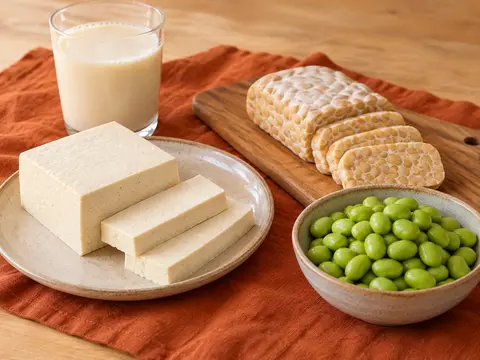
Soy foods and health: what human studies show
What tofu, tempeh and soy milk contribute to a vegan diet, with human evidence on cholesterol, hormones and thyroid concerns, plus supplement cautions.
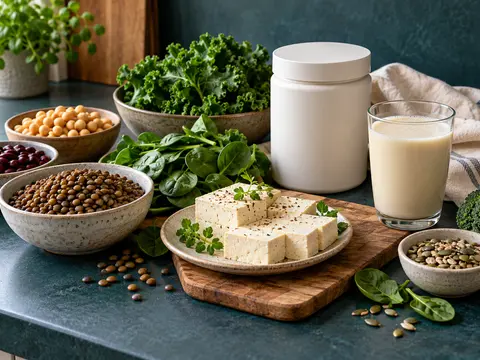
Which supplements might a vegan diet need?
Review B12, vitamin D, iodine, calcium, iron, zinc and omega-3 with a practical guide to food gaps, supplement labels and professional advice.